By William Waldner, Esq. — NYC bankruptcy attorney. I have practiced bankruptcy law since 2008, and my firm handles consumer bankruptcy cases exclusively in the Southern and Eastern Districts of New York.
Yes — you can rent an apartment in New York City after bankruptcy, and plenty of my clients sign leases within months of their discharge. A bankruptcy on your record is not a bar to renting; it’s a line item a landlord weighs alongside your income, your references, and your current ability to pay. In some ways a recent filer is a stronger applicant than they look, because the debt that would have competed with the rent is gone. The NYC rental market is genuinely tough — but it’s tough for everyone, and bankruptcy is rarely the thing that sinks an application.
This is one of the most common worries I hear, usually phrased as “will I even be able to find a place?” The honest answer is that it takes some strategy, not a miracle. Here’s how it actually works.
What a Landlord Actually Sees
A Chapter 7 bankruptcy stays on your credit report for up to ten years from the filing date; a Chapter 13 for up to seven. That sounds ominous, but understand what the landlord is really looking at. Most NYC landlords and brokers pull a credit report and a tenant-screening report, and what moves the needle is rarely the bankruptcy flag itself — it’s your score, your current income, and whether there are recent problems like an eviction filing or unpaid balances.
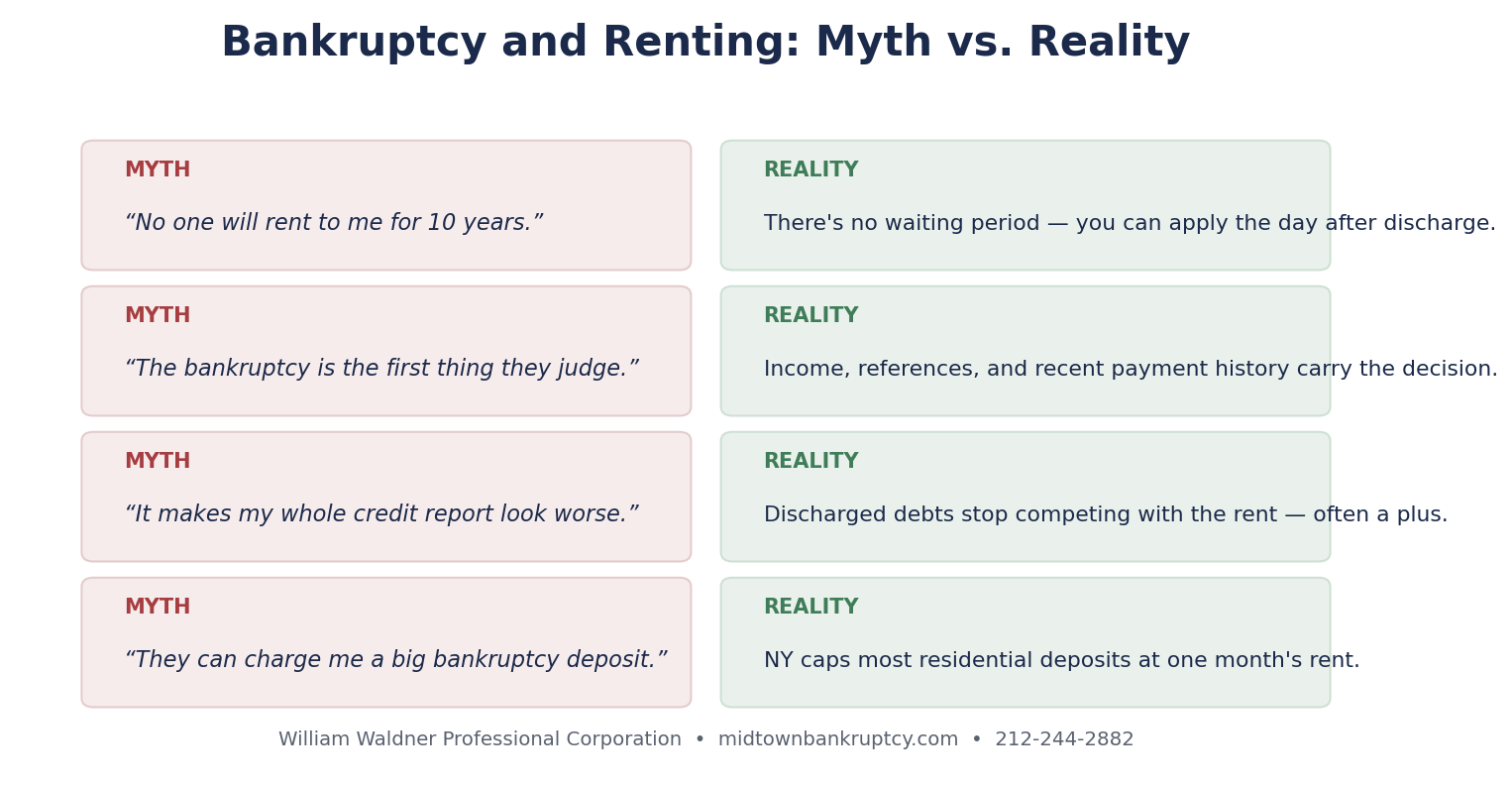
Here’s the counterintuitive part: a discharged bankruptcy can actually make the rest of your report look better. The old defaulted accounts are marked discharged rather than sitting there as active delinquencies, your debt-to-income ratio improves dramatically, and there’s nothing left for a new landlord to worry about being garnished or chased. A landlord’s real fear is a tenant who can’t pay the rent because other creditors are first in line. After discharge, no one is in line ahead of your landlord. That’s a point worth making directly in your application.
The NYC-Specific Rules That Work in Your Favor
New York City has tenant protections that quietly help a post-bankruptcy renter, and most applicants don’t know to use them:
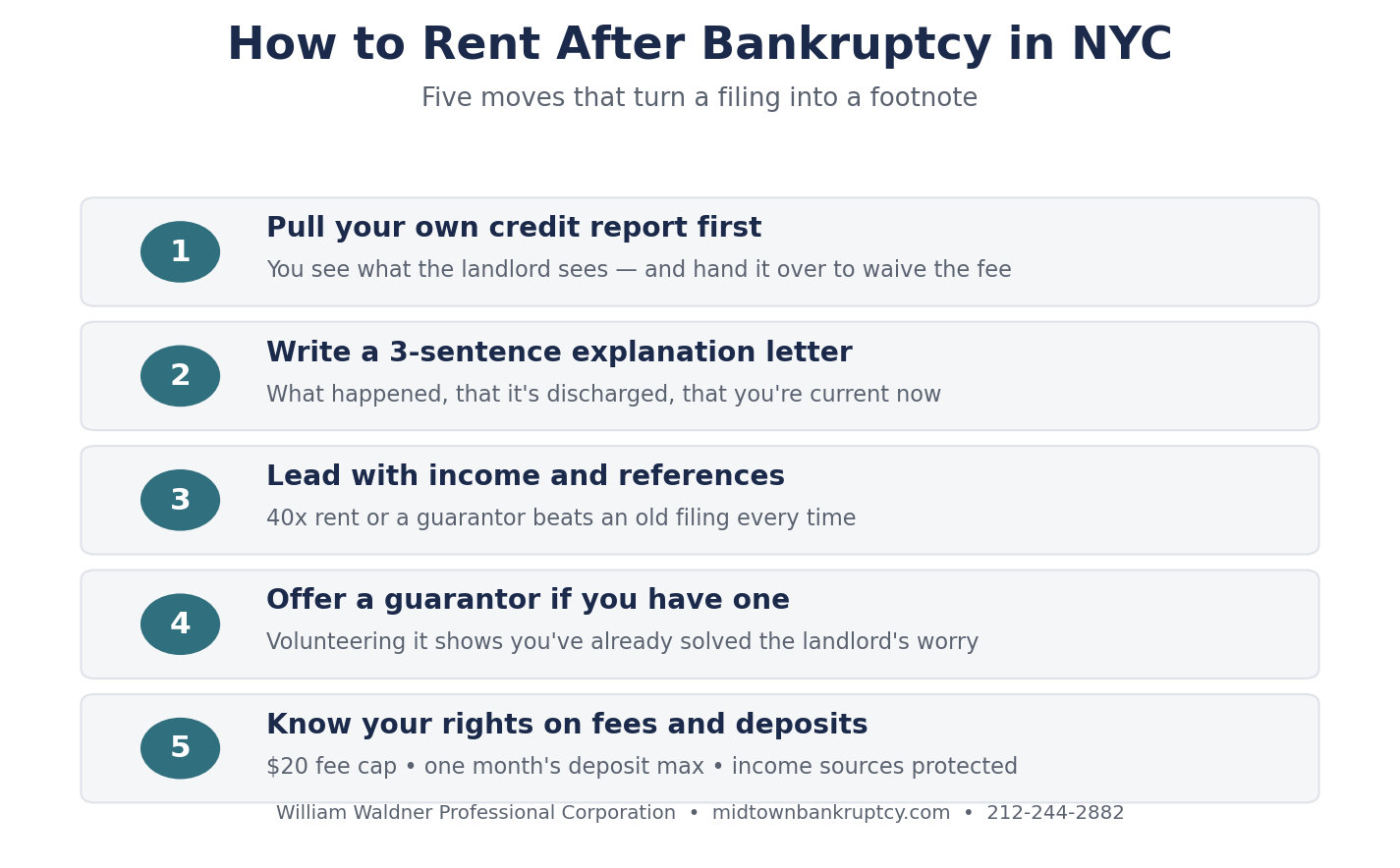
The application fee is capped. Statewide law limits a rental application fee to the actual cost of the background/credit check or $20, whichever is less — and if you hand the landlord your own credit and background check completed within the past 30 days, they must waive the fee entirely. Pulling your own report first also means you see exactly what the landlord will see, with no surprises.
Source-of-income discrimination is illegal. A NYC landlord cannot reject you for using a lawful income source — a voucher, a subsidy, or other lawful support all count as income and must be accepted. A landlord also can’t use a financial standard as a backdoor way to screen those out.
Income, not credit, usually drives the decision. Most NYC landlords want gross income of roughly 40 times the monthly rent (about 2.5–3x on a monthly basis), or a guarantor. If your income clears that bar, a discharged bankruptcy is frequently a footnote. This is exactly why filing to clear crushing debt can improve your rental prospects — the monthly obligations that dragged your budget down are gone, and your income stretches further. If you’re weighing whether your debt has reached that point, I cover the warning signs in my article on how much credit card debt is too much.
The Guarantor and the Bigger Deposit
Two tools close most gaps. A guarantor — someone who agrees to cover the rent if you can’t — reassures a nervous landlord instantly; many NYC tenants use one even without a bankruptcy. There are also institutional guarantor services that play this role for a fee if you don’t have a family member who can.
Landlords sometimes ask for a larger security deposit or a few months up front from an applicant with a thin or damaged credit file. Know the limit: under New York law, a residential security deposit on most apartments cannot exceed one month’s rent. If a landlord demands two or three months as a “bankruptcy deposit,” that’s not permitted for a standard residential lease — a point worth raising politely, because it often resolves in your favor.
How to Present Yourself
The applicants who struggle are usually the ones who let the bankruptcy speak for itself. The ones who succeed get ahead of it. A short, factual approach works:
- Pull your own credit report first so you know what’s on it and can hand it over — waiving the fee and controlling the narrative.
- Write a brief explanation letter. Two or three sentences: what happened (a medical event, a job loss, a divorce), that it’s discharged, and that you’re now current on everything. Landlords deal in risk, and a clear story reduces perceived risk.
- Lead with income and references. Recent pay stubs, an employment letter, and a good reference from a prior landlord outweigh an old filing.
- Offer a guarantor if you have one. Volunteering it signals you understand the landlord’s concern and have already solved it.
- Target individually owned buildings. Small landlords often have more flexibility than large management companies bound to rigid screening rules — many will weigh your explanation and current income over a checkbox credit score.
I’ve had clients go from a completed bankruptcy to a signed lease in a matter of weeks using exactly this approach. The filing is not the obstacle people fear — disorganization and silence are.
Frequently Asked Questions
How long after bankruptcy can I rent in NYC?
There’s no waiting period. You can apply immediately. Many landlords care more about recent payment behavior than an older filing, so being current on your rent and utilities right now matters more than the discharge date.
Do I have to tell a landlord about my bankruptcy?
If they run a credit check — and most NYC landlords do — it will appear, so it’s better to address it proactively than to have it surface as a surprise. You control the story far better by disclosing it with context.
Is it easier to rent after Chapter 7 or Chapter 13?
Both are fine. Chapter 7 clears from your report sooner in absolute terms once discharged, while in Chapter 13 you may still be inside a repayment plan — but a landlord who understands that a Chapter 13 filer has a court-supervised budget and steady income often views it favorably. Presentation matters more than the chapter.
Can a landlord reject me just for having filed bankruptcy?
Bankruptcy status isn’t a protected class, so a private landlord can consider it — but blanket “no bankruptcies” policies are rare in practice, and the moment income and references are strong, most landlords move forward. The law also bars them from using screening as a cover for source-of-income or other discrimination.
What if I need to rent during my Chapter 13 case?
It’s doable, and it comes up often. Being mid-plan isn’t disqualifying; a steady income and a clean recent payment history carry the application. If a lease requires anything unusual, that’s worth a quick conversation with your attorney.
Planning Your Fresh Start, Including the Apartment
A big part of what I do is help clients think past the filing to the life on the other side of it — and for many New Yorkers, that life includes finding a place to live without the old debt hanging over it. If you’re weighing bankruptcy and worried about the rental market afterward, that’s exactly the kind of practical question a consultation is for. Your first 20-minute consultation with my office is free.
William Waldner Professional Corporation — 469 Seventh Avenue, 12th Floor, New York, NY 10018
Call 212-244-2882 to schedule your free, confidential 20-minute consultation. We handle bankruptcy cases exclusively, in the Southern and Eastern Districts of New York.