By William Waldner, Esq. — NYC bankruptcy attorney. I have practiced bankruptcy law since 2008, and my firm handles consumer bankruptcy cases exclusively in the Southern and Eastern Districts of New York.
In New York, a creditor generally has only 3 years from your default to sue you on a credit card or other consumer debt — down from 6 years under a law that took effect in April 2022 — and once that window closes, the debt is “time-barred”: they cannot sue you, and no payment or acknowledgment can restart the clock. But here’s the trap: a judgment a creditor already obtained lasts 20 years. So the answer to “can they really come after a 10-year-old credit card?” is: not with a new lawsuit — but if they got a judgment back then, that judgment is very much alive, and it’s probably why your wages or bank account are suddenly in play.
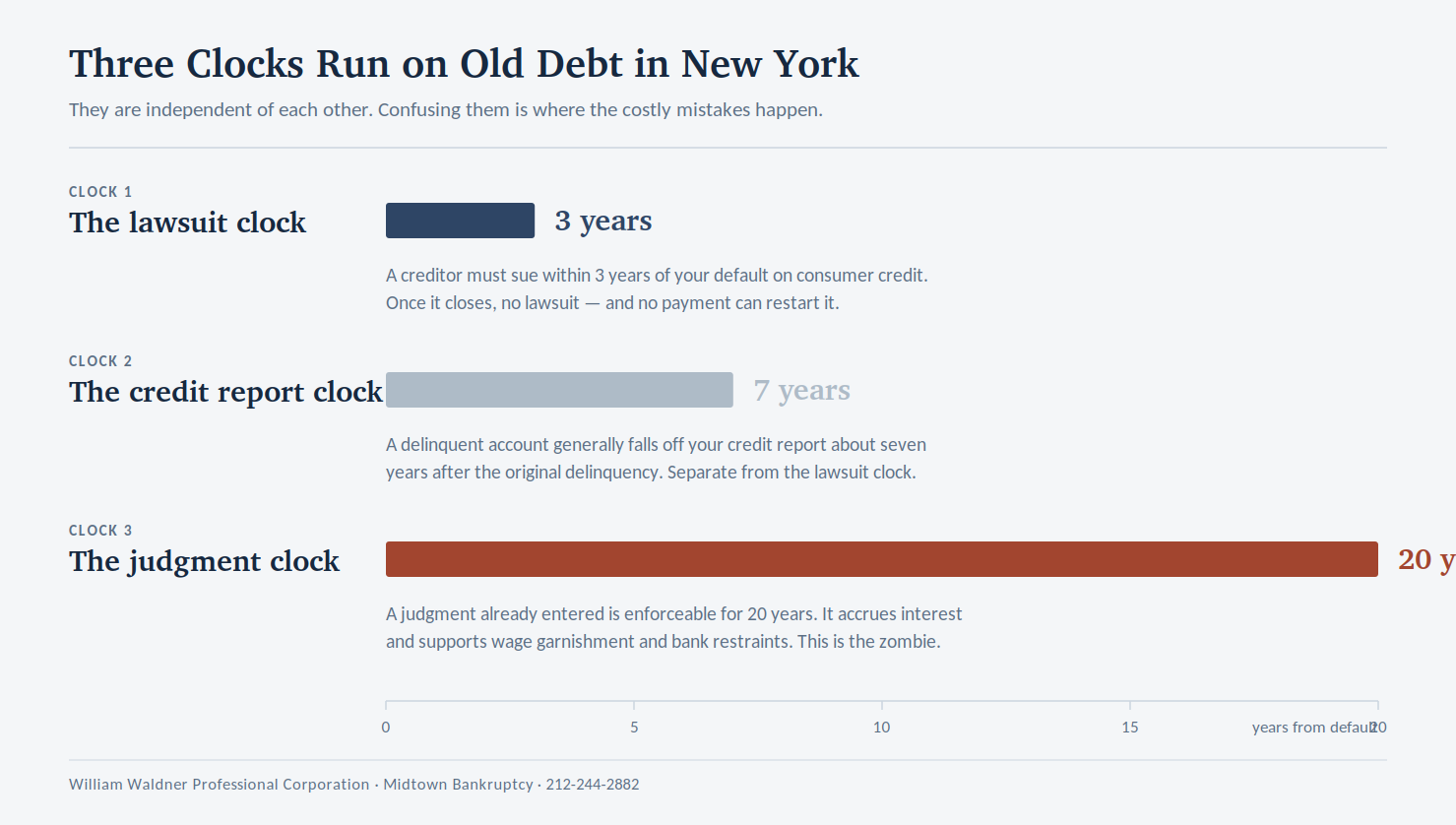
Old debt in New York runs on three different clocks, and most of the bad decisions I see people make come from confusing them. Let’s separate them.
The Three Clocks on Old Debt
Clock 1 — The lawsuit clock: 3 years. Under New York’s Consumer Credit Fairness Act, most collection lawsuits arising from consumer credit — credit cards, personal loans — must be filed within three years of your default. Two more protections came with it: making a payment or acknowledging the debt after the deadline no longer revives it (this used to be the collectors’ favorite trick — “just make one good-faith payment” — and it’s dead), and a collector who sues must attach the actual contract and identify the original creditor, documentation that debt buyers on ancient accounts frequently don’t have.
Clock 2 — The credit report clock: about 7 years. Separate from the lawsuit clock, a delinquent account generally falls off your credit report roughly seven years after the original delinquency. A debt can be time-barred for suit and still sit on your report; it can also be off your report and still be legally owed.
Clock 3 — The judgment clock: 20 years. If a creditor sued and won before the time ran out — even by default, even years ago — the resulting judgment is enforceable in New York for twenty years. It accrues interest, it can support a 10% wage garnishment and bank account restraints, and if you own real estate, it can sit as a lien against it. This is the zombie: a debt from 2014 that couldn’t be sued on today, animated indefinitely by a judgment you may not even remember being entered.
Time-Barred Doesn’t Mean the Debt Vanishes
Being past the three years means they can’t successfully sue you or even threaten to — collectors can still request payment within strict limits, but the leverage is gone. What it doesn’t do is erase the debt. You can choose to pay it or not; nothing bad legally happens if you don’t. Which leads to the question I get constantly:
“Should I make a small payment to show good faith?” Under current New York law, a payment can no longer revive an expired limitations period — but there is still rarely a reason to pay a debt no one can sue you on unless it’s blocking something you need. When a collector calls about a very old debt asking for “just something,” understand what that call is: a business trying to collect money it has no legal power to force from you.
The Catch: You Still Have to Show Up
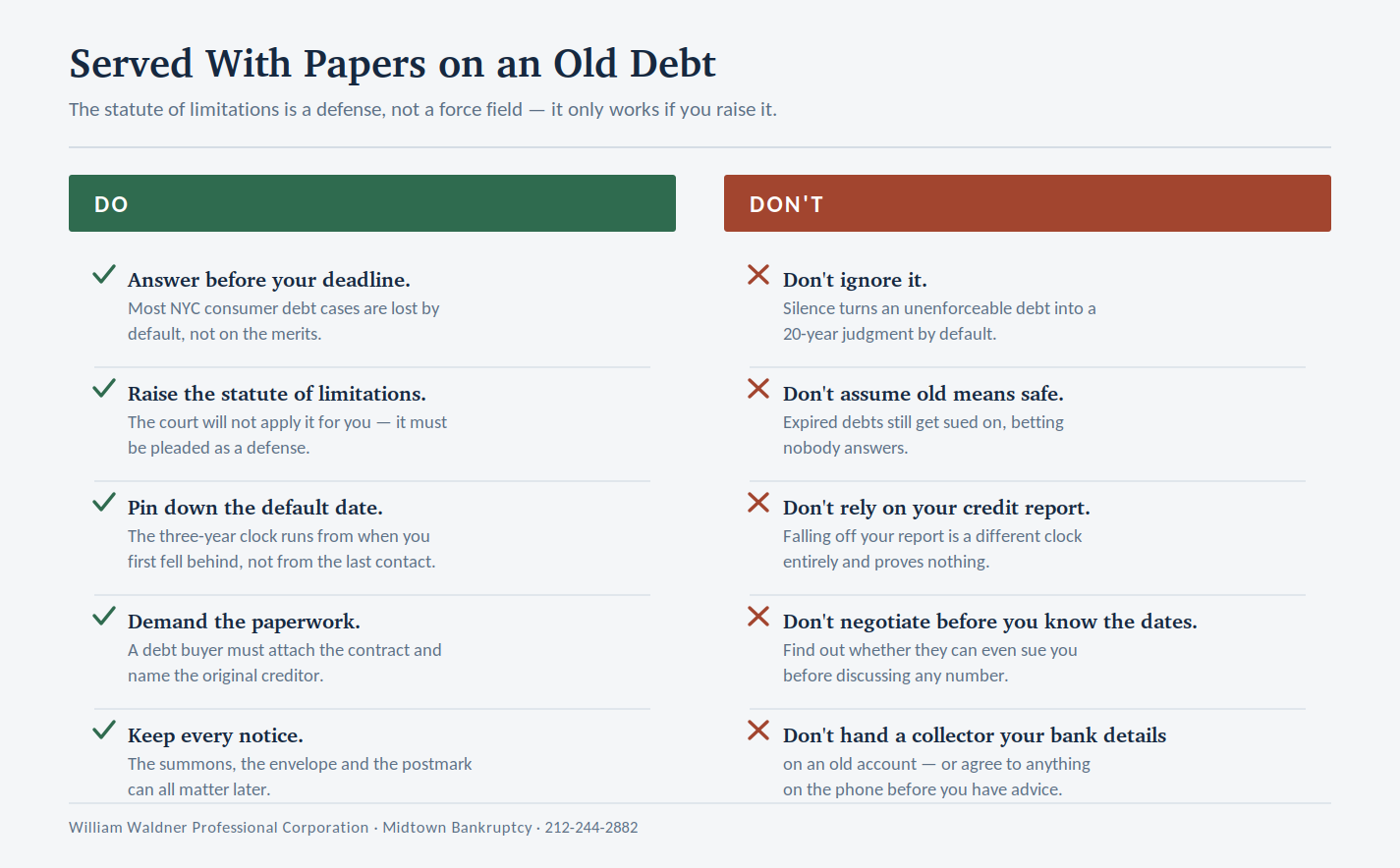
Here is where time-barred debt hurts people anyway. The statute of limitations is a defense, not a force field. If a debt buyer files a lawsuit on an expired debt — and some still do, betting nobody answers — the court will not throw it out automatically. If you ignore the papers, the collector gets a default judgment, and now the zombie is born: a debt that should have been unenforceable becomes a 20-year judgment because nobody said the magic words.
Most consumer debt lawsuits in New York City end exactly this way — by default. If you’re served with papers on an old debt, the single most valuable thing you can do is respond and raise the statute of limitations. Old debt-buyer cases frequently collapse when challenged, because the paperwork chain the law now requires simply doesn’t exist.
Already Have a Zombie Judgment? Your Three Moves
If an old judgment surfaces — usually announced by a frozen bank account or a garnishment notice — there are three paths:
1. Vacate it. If you were never properly served with the original lawsuit (extremely common in debt-buyer cases from the 2010s — “sewer service” was an epidemic), you can ask the court to vacate the default judgment and defend the case now, including on statute-of-limitations grounds.
2. Negotiate it. Judgment creditors holding old paper often settle for a fraction, especially when a vacatur motion is credible.
3. Discharge it in bankruptcy. This is the one people don’t realize: a judgment on a credit card debt is still just a credit card debt for bankruptcy purposes — fully dischargeable, no matter how old or how official the judgment looks. The filing stops the garnishment and unfreezes the account through the automatic stay, and if the judgment created a lien on your home, bankruptcy can often remove that lien too when it interferes with your protected equity. If a garnishment or bank restraint is already in motion, speed matters — that’s the scenario I covered in my article on when to file bankruptcy, and it’s what emergency bankruptcy filings exist for.
One judgment is often manageable. What I see more often is a person with three or four zombie judgments plus current debt — and at that point, a single bankruptcy filing that clears all of it at once is usually cheaper and faster than fighting each judgment separately.
Frequently Asked Questions
Can collectors still call me about a time-barred debt?
Within limits, yes — but they cannot sue or threaten to sue, even by implication. New York regulators have been explicit that suing or threatening suit on time-barred debt violates federal law. If a collector implies a lawsuit is coming on a debt past the three-year mark, they’ve likely just handed you a legal claim against them.
A judgment showed up on my property records but I was never sued — is that possible?
It usually means you were sued and never knew it, because service was defective or sent to an old address. That’s the strongest ground there is for vacating the judgment. Get the court file — the index number on the judgment tells you where to look.
Does the 3-year rule apply to my old medical bills or my landlord’s claim?
The three-year rule covers consumer credit transactions — credit cards, personal loans, financed purchases. Other debts run on different clocks, so don’t assume; the analysis takes minutes with the dates in hand.
The debt is off my credit report. Does that mean it’s gone?
No — the reporting clock and the lawsuit clock are independent. A debt can be invisible on your report and still within the lawsuit window, or visible and time-barred. Only the dates of default and judgment answer the real question.
Bring the Paperwork — the Dates Decide Everything
Whether you’ve been served fresh papers on an ancient account or discovered a judgment through a frozen account, the analysis starts the same way: when was the default, was there ever a judgment, and when. Bring whatever you have — a summons, a restraint notice, even just a collector’s letter — and in twenty minutes we can usually tell you whether the debt is time-barred, whether a judgment can be vacated, or whether one bankruptcy filing solves the whole pile at once. Your first 20-minute consultation with my office is free.
William Waldner Professional Corporation — 469 Seventh Avenue, 12th Floor, New York, NY 10018
Call 212-244-2882 to schedule your free, confidential 20-minute consultation. We handle bankruptcy cases exclusively, in the Southern and Eastern Districts of New York.