By William Waldner, Esq. — NYC bankruptcy attorney. I have practiced bankruptcy law since 2008, and my firm handles consumer bankruptcy cases exclusively in the Southern and Eastern Districts of New York.
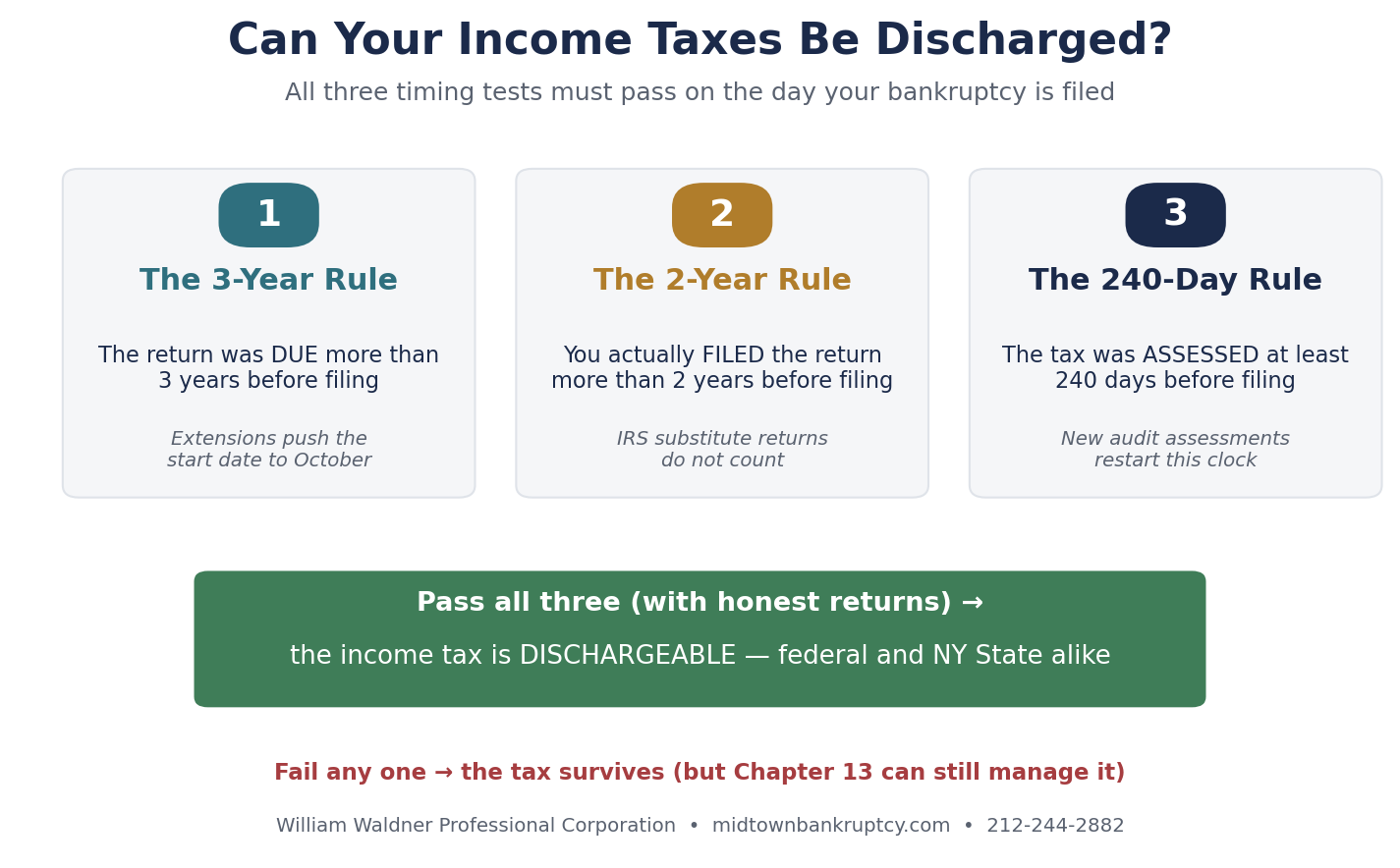
Yes — income taxes can be discharged in bankruptcy, and it happens more often than people think. But only income taxes, and only when they pass three timing tests: the return was due more than 3 years ago, you actually filed the return more than 2 years ago, and the IRS assessed the tax at least 240 days ago. Pass all three (and provided there was no fraud), and that tax debt can be wiped out in Chapter 7 like a credit card balance. Miss even one, and the tax survives — though Chapter 13 still offers a powerful way to deal with it.
The persistent myth is that “you can’t bankrupt taxes.” I discharge income tax debt for clients regularly. What’s true is that the rules are unforgiving about timing — and that’s actually good news, because timing is something you can plan.
The Three Timing Rules
All three must be satisfied on the day your bankruptcy case is filed. Walk through them with a real example: your 2022 federal income taxes.
Rule 1 — The 3-Year Rule. The tax return must have been due more than three years before your bankruptcy filing. Your 2022 return was due in April 2023, so the three-year clock ran out in April 2026. A case filed today passes this test for 2022 and every earlier year. Important: if you requested an extension that year, the clock starts from the extended due date in October, not April.
Rule 2 — The 2-Year Rule. You must have actually filed the return more than two years before your bankruptcy case. If you filed your 2022 return on time in April 2023, you cleared this test in April 2025. But if you filed that same return late — say, in September 2024 — the two-year clock started then, and a bankruptcy filed before September 2026 would not discharge it. (Late-filed returns can also raise thornier legal complications in some courts, which is exactly the kind of wrinkle to review with an attorney before filing.)
Rule 3 — The 240-Day Rule. The IRS must have assessed the tax at least 240 days before your filing. For most people, assessment happens automatically within weeks of filing the return, so this test takes care of itself. It matters when there’s been a recent audit adjustment or amended return — a fresh assessment restarts the 240 days. An offer in compromise or a prior bankruptcy pauses this clock, too.
Pass all three, with honestly filed returns, and the income tax — federal or New York State — is dischargeable.
The Substitute Return Trap
Here’s the trap that catches more people than any other. If you don’t file a return, the IRS eventually files one for you — a “substitute for return” — and assesses tax based on it. That assessment feels official, and people assume the two-year clock is running.
It isn’t. A substitute return filed by the IRS does not count as you filing a return. Taxes assessed on a substitute return are generally not dischargeable, no matter how many years pass — because Rule 2 is never satisfied. If you have unfiled years, the path to ever discharging those taxes starts with filing your own returns and then letting the clock run. This is one of the most consequential conversations I have with clients who’ve fallen behind, and it’s why “just wait it out” is exactly the wrong strategy for unfiled years.
Taxes That Never Discharge
Some tax debts fail no matter how much time passes:
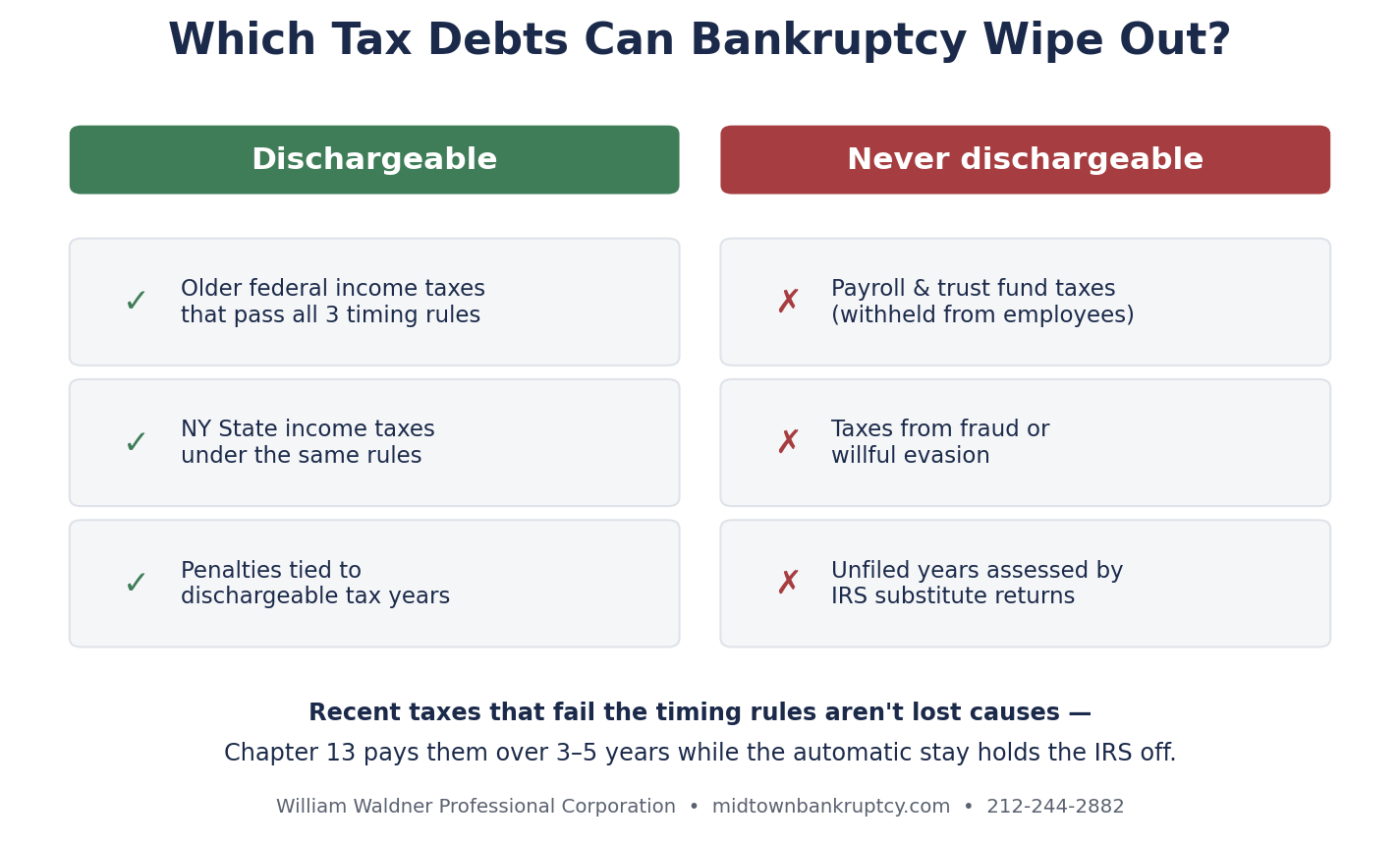
- Trust fund and payroll taxes — money withheld from employees’ paychecks. If you ran a business and payroll taxes went unpaid, that portion follows you.
- Taxes from fraudulent returns or willful evasion — dishonesty on the return removes it from discharge entirely.
- Recent taxes — anything that fails the three timing rules above, including the most recent tax years by definition.
- Certain penalties and other tax types — sales tax you collected, for instance, is treated like trust fund money.
When the Taxes Don’t Qualify: The Chapter 13 Option
Failing the timing rules doesn’t mean bankruptcy has nothing to offer. Recent income taxes are “priority” debts, and a Chapter 13 plan pays them over three to five years with two enormous advantages over an IRS installment agreement: the automatic stay stops IRS collection — levies, garnishments, the letters — the day you file, and penalties generally stop accumulating inside the plan. I’ve had clients enter Chapter 13 owing recent taxes alongside credit card debt and walk out five years later with the taxes paid, the cards discharged, and the IRS entirely out of their lives.
And sometimes the smartest move is hybrid: wait for an older year to cross its three-year or two-year threshold, then file. A few months of patience can flip a five-figure tax debt from “must be paid” to “discharged.” That calculation is a core part of the timing strategy I described in my article on when to file bankruptcy — with taxes, filing on the right date isn’t a detail, it’s the whole game.
One Caveat: Tax Liens
If the IRS recorded a tax lien against your property before you filed, the discharge eliminates your personal obligation to pay — the IRS can no longer garnish, levy, or sue you — but the lien itself survives against property you owned when the case was filed. For renters with no significant assets, this is usually academic. For homeowners, it’s a real planning point: the goal is to file before a lien is recorded whenever possible. One more reason timing conversations should happen early.
Frequently Asked Questions
Do New York State taxes follow the same rules?
Substantially, yes — state income taxes are analyzed under the same three timing rules and are dischargeable on the same basis. New York State’s collection tactics (income executions, bank levies) are stopped by the automatic stay just like the IRS’s.
Will filing bankruptcy stop an IRS levy or wage garnishment?
Yes, immediately. The automatic stay applies to the IRS the same as any other creditor. The IRS is aggressive before a bankruptcy and remarkably compliant after one — they know the rules and follow them.
I haven’t filed returns for several years. Can I still file bankruptcy?
Yes, but get the returns filed first. Chapter 13 requires your recent returns, and for Chapter 7 the unfiled years’ taxes won’t discharge regardless. Filing the returns starts the clocks that eventually make those taxes dischargeable.
Does filing bankruptcy trigger an audit?
No. There’s no evidence bankruptcy filers are audited at higher rates. The IRS reviews your case through the bankruptcy system like every other creditor.
Find Out Which of Your Tax Years Qualify
This is one area where a twenty-minute conversation can be worth a very large amount of money: bring your IRS notices (or just your memory of which years you owe), and we can usually determine on the spot which years are dischargeable now, which become dischargeable if we wait, and which need a Chapter 13 plan. Your first 20-minute consultation with my office is free.
William Waldner Professional Corporation — 469 Seventh Avenue, 12th Floor, New York, NY 10018
Call 212-244-2882 to schedule your free, confidential 20-minute consultation. We handle bankruptcy cases exclusively, in the Southern and Eastern Districts of New York.