By William Waldner, Esq. — NYC bankruptcy attorney. I have practiced bankruptcy law since 2008, and my firm handles consumer bankruptcy cases exclusively in the Southern and Eastern Districts of New York.
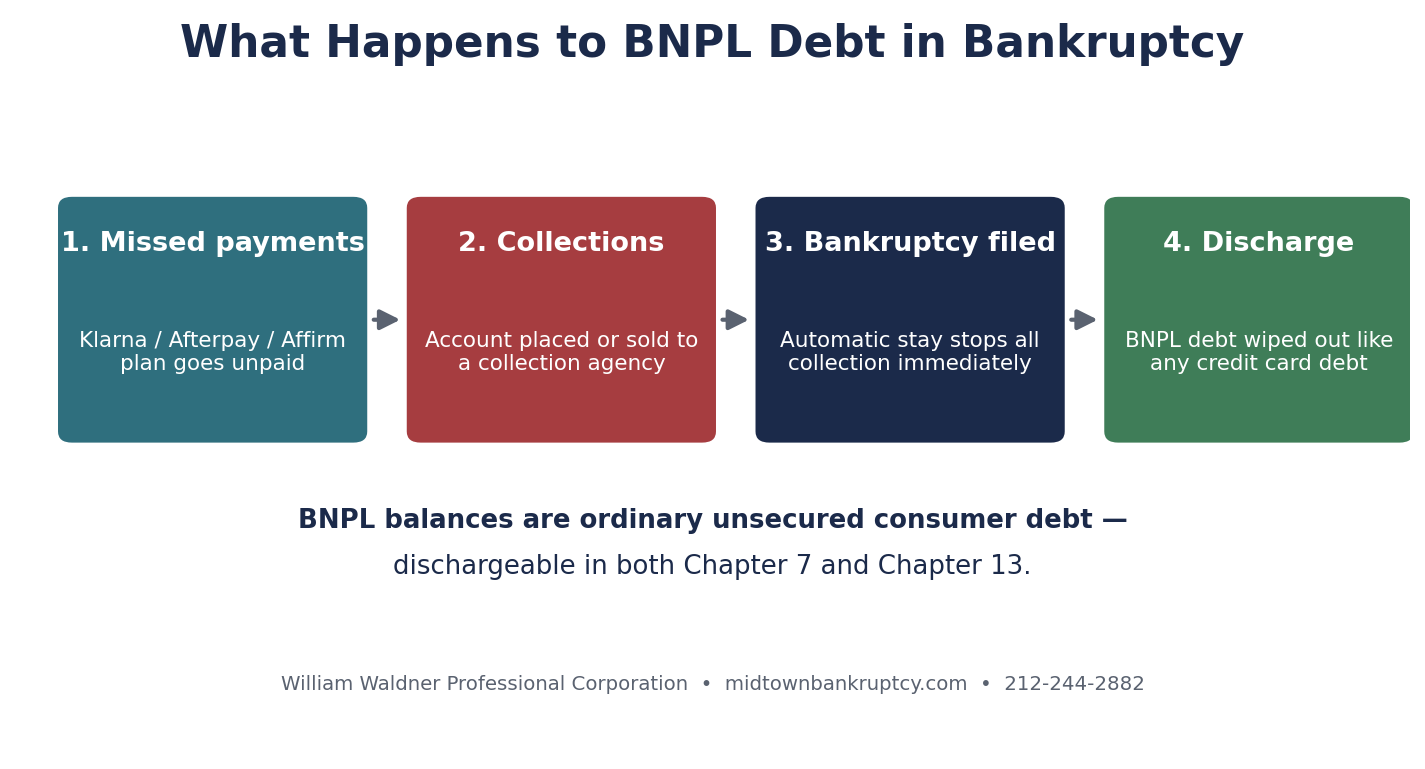
Yes, Klarna, Afterpay, and Affirm send unpaid balances to debt collectors — and yes, buy-now-pay-later debt can be wiped out in bankruptcy. BNPL balances are ordinary unsecured consumer debt, legally no different from a credit card, which means they are dischargeable in both Chapter 7 and Chapter 13. The complications aren’t legal — they’re practical: BNPL debt is easy to lose track of, often invisible on your credit report, and spread across apps you may have forgotten you signed up for. That’s where people get tripped up, and it’s what this article is really about.
Five years ago, buy-now-pay-later balances almost never appeared in the bankruptcy petitions I filed. Now they’re in a large share of them — usually not as one big debt, but as six or eight small ones that quietly added up to real money.
Yes, Klarna Sends Debt to Collections
Let’s clear up the question that brings most people to this page. The “four easy payments” branding makes BNPL feel like something softer than credit — but a missed BNPL plan follows the same path as any defaulted loan. The provider attempts to collect, then places or sells the account to a collection agency or debt buyer. If a collector is contacting you about a Klarna, Afterpay, Affirm, Zip, or PayPal “Pay in 4” balance, that debt is fully real, it can end up in a lawsuit like any other unsecured debt, and — the good news — it can be discharged like any other unsecured debt.
Once you file bankruptcy, the automatic stay stops BNPL collectors the same way it stops credit card collectors: immediately, by federal law.
The “Invisible Debt” Problem
Here’s what makes BNPL genuinely different in a bankruptcy case: much of it doesn’t show up on your credit report. The reporting landscape is a patchwork — some providers report their longer financing plans to some bureaus, most short “pay in 4” plans are reported inconsistently or not at all, and the credit scoring industry is still in the middle of catching up to BNPL entirely.
Why does that matter? Because when I prepare a bankruptcy petition, every creditor must be listed. For credit cards, your credit report catches nearly everything. For BNPL, it can’t be trusted. A client who tells me “I pulled my credit report and listed everything on it” may still have four unpaid pay-later plans sitting in apps on their phone.
So BNPL requires its own inventory step: open every shopping and payment app — Klarna, Afterpay, Affirm, Zip, Sezzle, PayPal, plus BNPL options embedded in store apps and checkout pages — and screenshot every active or delinquent plan. Bring that to your attorney. A debt that isn’t listed may not be discharged, and there is no reason to let a $340 sneaker balance survive your bankruptcy on a technicality.
Small Plans, Real Money
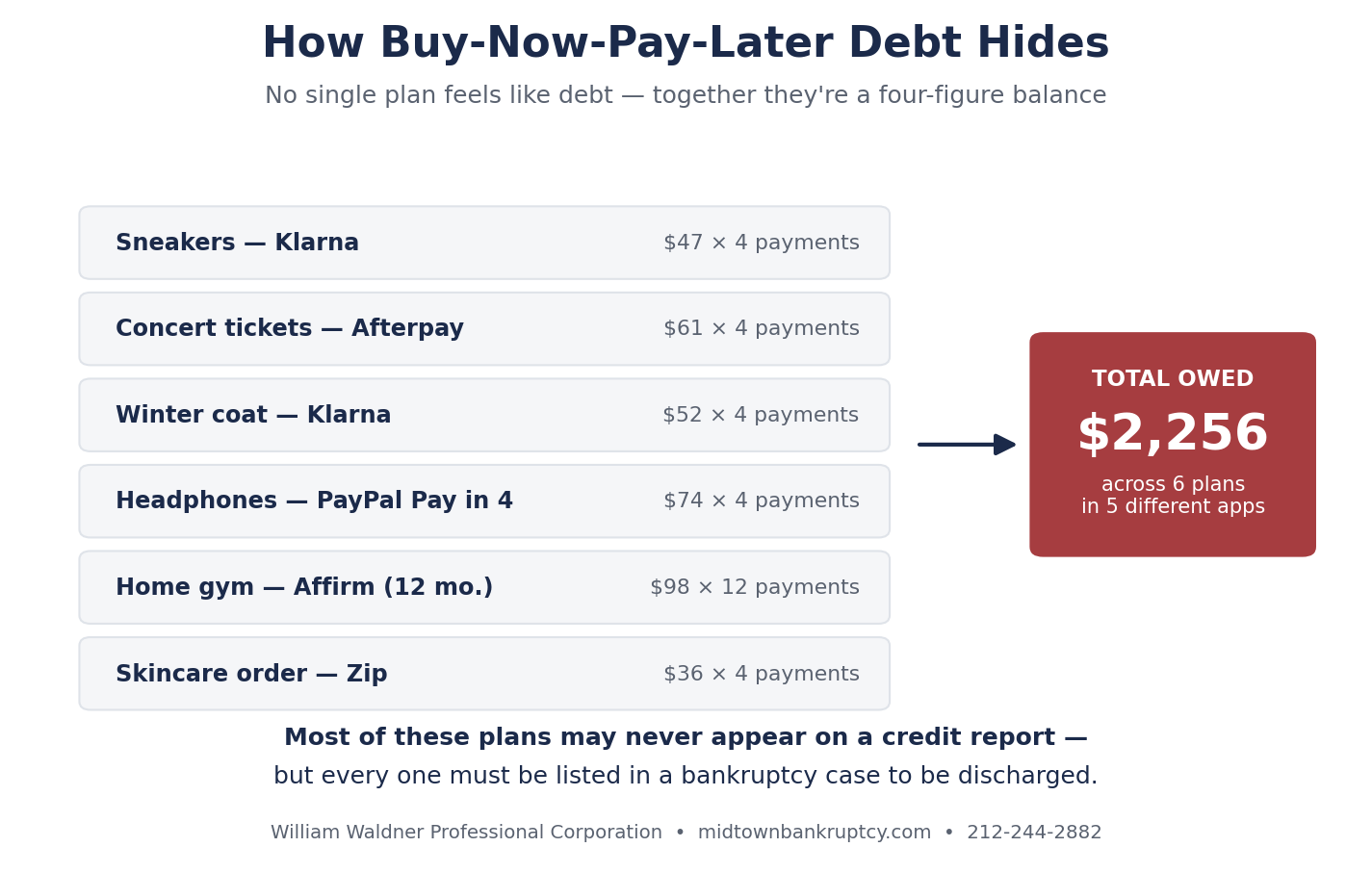
The other trap is psychological. No single BNPL plan feels like debt — $47 every two weeks doesn’t register the way a $4,000 card balance does. But the structure invites stacking. A typical picture from my consultations: five or six active plans across three apps, $250–$400 coming out in combined biweekly payments, and no single place where the total is visible. Multiply that across months of new purchases and BNPL becomes a four-figure debt that the borrower genuinely cannot estimate within $1,000 when I ask.
If you can’t state your total BNPL balance right now, that itself is worth noticing. It’s the modern version of not opening the credit card statement.
Two Nuances Worth Knowing
Some Affirm loans are secured. Most BNPL is unsecured, but certain longer Affirm financings — larger purchases like exercise equipment or furniture — can include a purchase-money security interest in the item. In plain English: the item is technically collateral. In practice, lenders almost never repossess used consumer goods; the resale value doesn’t justify the cost. But secured status changes how the debt is handled in your case, so your attorney needs to see the loan terms, not just the balance.
Recent BNPL sprees can raise timing questions. Like credit cards, significant purchases shortly before filing can invite scrutiny under the Bankruptcy Code’s presumption rules for recent luxury charges. If your BNPL activity is very recent, the answer is usually not “don’t file” — it’s “file on the right date.” I’ve covered how those windows work in my article when to file bankruptcy.
Frequently Asked Questions
Do I have to list a $60 Afterpay balance in my bankruptcy? Yes. Every debt gets listed, no matter how small. Listing it costs you nothing — the discharge covers it along with everything else.
Will they take back the things I bought? For ordinary unsecured BNPL plans, no — there’s no repossession right, and nobody is coming for your clothes or concert tickets. For the rare secured Affirm-style loan, repossession is theoretically possible but almost never economically worthwhile for the lender.
Can I keep using Klarna or Afterpay after I file? Expect the accounts to be closed once the provider gets notice of your case. Frankly, for someone exiting bankruptcy, that’s a feature: the pay-in-4 structure is precisely the kind of frictionless borrowing that makes fresh starts fail.
Does BNPL debt affect my credit score? Inconsistently — some plans are reported to credit bureaus, many aren’t, and scoring models that formally include BNPL are still rolling out across the industry. That’s exactly why you can’t rely on a credit report to find these debts before filing.
A collector is suing me over a BNPL balance. Can bankruptcy stop it? Yes. The automatic stay stops the lawsuit the day your case is filed, and the underlying debt is dischargeable like any other unsecured consumer debt.
Bring Your Phone to the Consultation
I mean that literally. In 2026, a complete picture of your debts lives partly in your apps, not just your credit report. If BNPL balances are part of what’s weighing on you — or if a collector has started calling about one — bring your phone and twenty minutes, and we’ll get the full picture together. Your first 20-minute consultation with my office is free.
William Waldner Professional Corporation — 469 Seventh Avenue, 12th Floor, New York, NY 10018 Call 212-244-2882 to schedule your free, confidential 20-minute consultation. We handle bankruptcy cases exclusively, in the Southern and Eastern Districts of New York.