By William Waldner, Esq. — NYC bankruptcy attorney. I have practiced bankruptcy law since 2008, and my firm handles consumer bankruptcy cases exclusively in the Southern and Eastern Districts of New York.
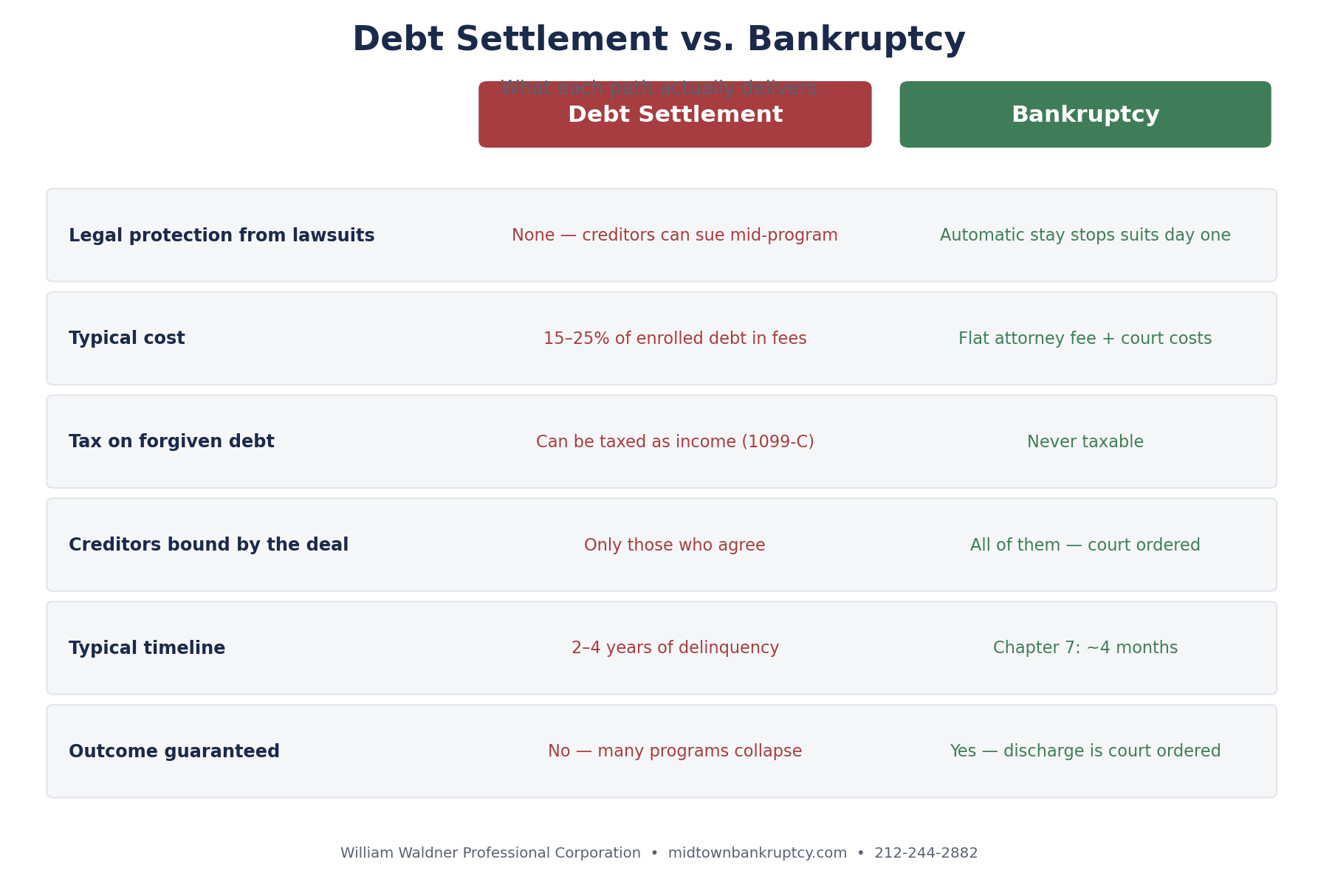
Debt settlement and bankruptcy both aim to resolve debt for less than you owe — but they are not close cousins. Settlement is a private negotiation with no legal protection: creditors can sue you mid-program, the company’s fees typically run 15–25% of your enrolled debt, and forgiven balances can be taxed as income. Bankruptcy is a federal legal process that stops lawsuits and collections the day you file, resolves all your unsecured debts at once, and taxes none of the discharged amount. For most New Yorkers with serious debt, that difference decides the question. But not always — and I’ll tell you when settlement genuinely makes sense, too.
I should be upfront about my perspective: I’m a bankruptcy attorney, so you’d expect me to favor bankruptcy. But a meaningful part of my consultations since 2008 have been with people who tried debt settlement first — usually after seeing an ad promising to “cut your debt in half without bankruptcy” — and arrived in my office two years later with less money, worse credit, and a lawsuit. This article is what I wish someone had told them at the start.
How Debt Settlement Actually Works
The model is simple, and the ads leave out most of it. You stop paying your creditors. Instead, you deposit money each month into a dedicated account. Once enough accumulates — and once your accounts are badly delinquent — the settlement company offers each creditor a lump sum, typically 40–60% of the balance, to close the account.
Notice what powers the strategy: deliberate default. Creditors don’t settle current accounts. The program only works because your accounts are being driven into deep delinquency, on purpose, with your name on every missed payment.
What the Ads Don’t Mention
The fees are enormous. Settlement companies typically charge 15–25% of your enrolled debt — not of the savings. Enroll $60,000 and the fee runs $9,000–$15,000, layered on top of what you pay creditors. Compare that to the total cost of a Chapter 7 case and the math gets uncomfortable fast.
You can be sued mid-program. Nothing about a settlement program stops a creditor from filing a lawsuit while you’re diligently making deposits. I’ve reviewed many programs from the wreckage end, and this is the most common failure mode: eighteen months in, one creditor sues, gets a judgment, and starts garnishing wages — which drains the money that was supposed to fund the other settlements. The program collapses, the fees are spent, and the debt is still there.
Forgiven debt can be taxable. When a creditor forgives $20,000, the IRS may treat that as $20,000 of income to you, reported on Form 1099-C. Unless you qualify for the insolvency exclusion, you can trade a credit card balance for a tax bill. Debt discharged in bankruptcy, by contrast, is never taxable income. Not a dollar of it.
There’s no group discount on your credit. People choose settlement to “avoid the credit damage of bankruptcy.” But the strategy requires months or years of missed payments, charge-offs, and collections — the exact entries that crater a credit score. In my experience, clients who complete a bankruptcy often rebuild faster, because their debt-to-income ratio resets to zero on day one rather than bleeding out over a multi-year program.
Completion rates are poor. Programs run two to four years and depend on every creditor cooperating and no lawsuit derailing the account. Many people pay substantial fees and never reach the finish line.
What Bankruptcy Does Differently
The moment a bankruptcy case is filed, the automatic stay — a federal injunction — stops collection activity: lawsuits, garnishments, frozen accounts, phone calls, all of it. No creditor gets to opt out. There is no negotiation phase where one holdout can sink the plan.
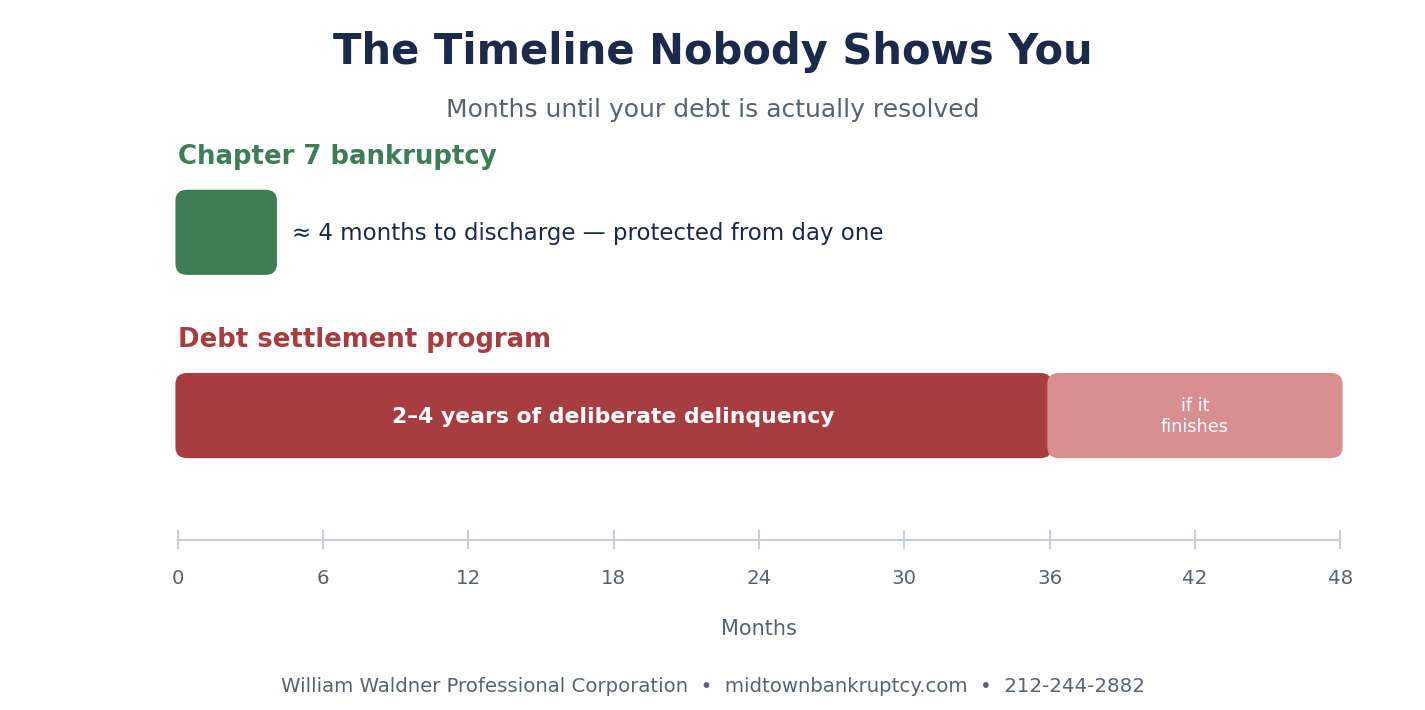
A Chapter 7 case typically discharges credit cards, personal loans, and medical debt in about four months. A Chapter 13 case restructures debt into a three-to-five-year plan, often at a fraction of what’s owed, with the balance discharged at the end. Either way, the result is court-ordered, binding on every creditor, and tax-free.
And the timeline comparison is stark: a settlement program is two to four years of delinquency with no legal protection. A Chapter 7 is often over before a settlement company has finished collecting its first year of fees.
When Debt Settlement Actually Makes Sense
Fairness requires this section, because settlement is the right answer for a narrow group:
- You have one or two creditors, not eight. A single negotiated deal — ideally done by an attorney, not a percentage-fee company — can work cleanly.
- You have a lump sum available now. Settlement works best as one transaction, not a multi-year drip.
- You can’t file or shouldn’t file. If you received a Chapter 7 discharge recently, or filing would put valuable non-exempt assets at risk, negotiation may be the practical route.
- The debt is small. If the total is modest relative to your income, a direct workout can beat any formal process.
If you recognize yourself in that list, negotiate — carefully, in writing, with the tax consequences understood before you sign. If you don’t, be honest about what the settlement pitch is selling you: bankruptcy’s outcome, without bankruptcy’s protections, at a higher price.
Frequently Asked Questions
Can I switch from a settlement program to bankruptcy?
Yes, and people do it every week. Money already paid in fees is generally gone, but filing stops the lawsuits and resolves the accounts the program couldn’t. If your program has stalled, don’t ride it down — get a second opinion.
Will bankruptcy hurt my credit more than settlement?
Both hurt. The difference is trajectory: settlement damage accumulates for years while accounts stay delinquent; bankruptcy takes the hit at once and starts the rebuild immediately. Many of my clients see scores recover within 12–24 months of discharge.
The settlement company says bankruptcy should be a “last resort.” Is that true?
Consider the source — that line appears in nearly every settlement pitch. Bankruptcy is a tool with 200 years of history in American law, used by individuals and major corporations alike. The right question isn’t which option sounds more drastic; it’s which one actually resolves your debt at the lowest total cost, with the most protection, in the least time.
How much does bankruptcy cost compared to settlement?
Attorney’s fees for a consumer case are typically a fraction of the 15–25% a settlement company charges on a five-figure debt — and unlike settlement fees, they buy you a legally guaranteed result. Ask both for their all-in number and compare directly.
Get a Real Comparison for Your Numbers
The honest way to choose is side by side: your actual debts, your actual budget, the total cost of each path, and the realistic timeline. That’s a twenty-minute conversation, and I’ll tell you plainly if settlement is the better fit for your situation. Your first 20-minute consultation with my office is free.
William Waldner Professional Corporation — 469 Seventh Avenue, 12th Floor, New York, NY 10018
Call 212-244-2882 to schedule your free, confidential 20-minute consultation. We handle bankruptcy cases exclusively, in the Southern and Eastern Districts of New York.